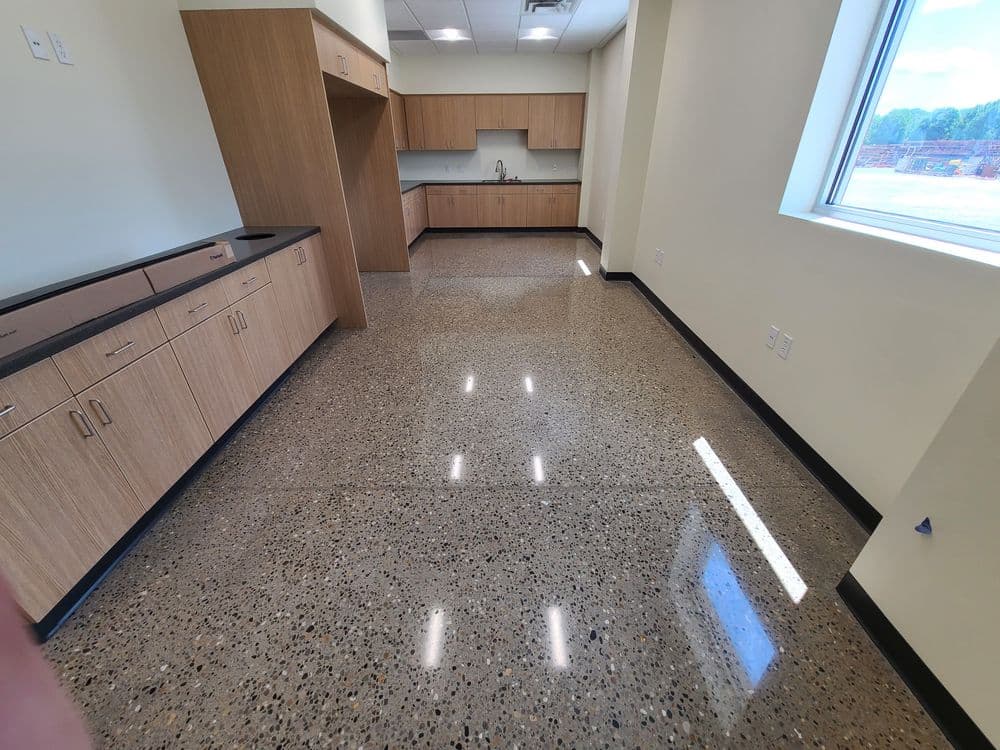
Polished Concrete Floors in Indianapolis & Central Indiana
Indy Floor Coating mechanically grinds, hones, densifies, and polishes existing concrete to create durable, low-maintenance finished floors for commercial and industrial facilities throughout Indianapolis and Central Indiana.
Polished Concrete Details
What Is Polished Concrete?
Polished concrete is a multi-step mechanical process that uses progressively finer diamond tooling to grind, hone, and polish an existing concrete slab to a smooth, refined finish. The result is a dense, hardened surface with a natural sheen that reflects light, resists wear, and requires minimal upkeep.
Unlike coatings that sit on top of the concrete, polished concrete works with the slab itself — densifying and refining the surface from within. There's nothing to peel, chip, or reapply. What you get is the concrete, at its best.
This makes polished concrete fundamentally different from epoxy, polyurea, polyaspartic, and other resinous floor coatings that create a separate film or coating system over the concrete.
Is Polished Concrete Right for Your Space?
Polished concrete is an excellent fit for commercial and industrial environments where long-term durability, low maintenance, and a clean professional appearance all matter. We most commonly install it in:
Commercial and retail spaces — a sleek, high-end appearance that holds up under constant foot traffic and is easy to keep clean
Warehouses and distribution centers — extremely durable, resistant to forklift and pallet jack traffic, and far easier to maintain than untreated concrete
Showrooms — polished concrete creates a refined, upscale backdrop that lets your products speak for themselves
Office and mixed-use spaces — low maintenance, long lasting, and increasingly popular as a modern design choice in commercial interiors
Manufacturing and industrial facilities — durable flooring for facilities exposed to equipment, carts, foot traffic and routine maintenance where a coating system isn't required.
If your space needs a floor that performs for decades without constant attention, polished concrete is worth a serious look.
Polish Levels — Finding the Right Finish for Your Space
Not every polished concrete floor looks the same. The final appearance depends on how deep we grind and how fine we finish. We work at all levels and recommend the right one based on your slab, your space, and your goals.
Cream Polish
A lighter grind that refines the surface layer of the concrete without exposing aggregate. Produces a smooth, matte-to-satin finish. Best for slabs in good condition where a subtle, natural look is the goal.
Salt and Pepper
A medium grind that opens the surface slightly and reveals fine aggregate — giving the floor a speckled, textured appearance with more visual depth. One of the most popular finishes for commercial interiors.
Full Aggregate Exposure
A deeper grind that reveals the larger stones within the concrete mix, creating a terrazzo-like appearance with bold visual character. Best suited for slabs with quality aggregate worth showcasing.
We'll assess your slab and walk you through what's achievable before any grinding begins — no surprises.
Polished Concrete Finish & Aggregate Exposure Options
Aggregate exposure: Cream → Salt & Pepper → Full Aggregate
Sheen: Matte/low sheen → Satin → Higher-gloss polished finish
How Our Polished Concrete Process Works
Step 1 — Surface Assessment
We evaluate the condition, hardness, and aggregate composition of your slab before we start. This determines the right tooling, grit sequence, and finish level for your specific floor.
Step 2 — Coarse Grinding
We begin with coarse diamond tooling to remove surface imperfections, old coatings or residue, and weak material — and to reach the desired depth of aggregate exposure.
Step 3 — Progressive Honing
We work through a sequence of progressively finer diamond grits, refining the surface with each pass. This is what builds the density, smoothness, and reflectivity of the finished floor. Skipping grits is a shortcut that produces inferior results — we don't do it.
Step 4 — Concrete Densifier Application
A chemical densifier is applied to the slab, penetrating the concrete and reacting with it to increase surface hardness and reduce porosity. This step is essential for long-term durability and is what separates a true polished concrete system from a basic grind and seal.
Step 5 — Fine Polishing
We finish with fine and ultra-fine diamond tooling to bring the surface to the desired sheen level — from a low-sheen matte to a high-gloss reflective finish.
Step 6 — Final Polish, Protection & Inspection
Application of a final stain protection/guard treatment before we walk the floor with you and confirm the finish meets expectations.
Benefits of Polished Concrete
Durable under heavy traffic
Low-maintenance
No traditional resinous coating to peel or delaminate
Multiple sheen and aggregate-exposure options
Improved surface hardness through densification
Uses the existing concrete slab as the finished floor
Suitable for large commercial and industrial spaces
Long service life with proper maintenance
Why Indianapolis Businesses Choose Indy Floor Coating
Indy Floor Coating has been serving Indianapolis and Central Indiana since 2008. As a local, family-owned company, we bring nearly two decades of concrete flooring experience to commercial and industrial projects of all sizes.
Our team evaluates each facility, slab condition, performance requirement, and desired finish before recommending a flooring system. That means we'll recommend polished concrete when it's the right fit — and a coating or sealed concrete system when it isn't.
Polished Concrete Floors: What You Should Know
How is polished concrete different from grind and seal?
Both processes begin with grinding the concrete surface, but they diverge after that. Grind and seal applies a protective sealer or coating over the prepared surface. Polished concrete continues refining the slab itself through progressively finer diamond tooling and a chemical densifier — producing a harder, denser surface with no topcoat required. Polished concrete is generally the longer-lasting, lower-maintenance option for commercial and industrial environments.
What's the difference between polished concrete and epoxy flooring?
Polished concrete mechanically refines and densifies the existing concrete slab, while epoxy flooring creates a separate resinous coating over the concrete. Polished concrete is often selected for warehouses, retail spaces, offices, showrooms, and industrial facilities where durability and low maintenance are priorities. Epoxy and other resinous coating systems may be a better fit when the space requires a seamless coating, greater chemical resistance, added texture, decorative broadcast aggregate, or other specific performance characteristics.
Does polished concrete get slippery?
A common concern — and a reasonable one. Polished concrete at lower sheen levels has a similar coefficient of friction to other hard floor surfaces. Higher gloss finishes can be more slippery when wet, which is why we discuss finish level and intended use before recommending a sheen. For spaces with wet conditions, we typically recommend a lower sheen or an alternative system like quartz.
Can any concrete slab be polished?
Most slabs can be polished, but the quality of the result depends on the condition and composition of the concrete. Severely damaged, contaminated, or low-quality slabs may not be good candidates for polishing, or may require significant remediation first. We assess every slab before committing to a scope of work and give you an honest answer about what's achievable.
How long does polished concrete last?
A properly executed polished concrete floor — with the right densifier and finish — can last decades with routine maintenance. It's one of the longest-lasting flooring options available for commercial and industrial environments.
What does maintenance look like for a polished concrete floor?
Day-to-day maintenance is straightforward — regular dust mopping to remove abrasive particles and occasional damp mopping with a neutral cleaner. Periodic application of a concrete guard or hardener can extend the life and appearance of the finish. We'll walk you through a maintenance plan before we leave the job.
How long does installation take?
Project timelines vary based on square footage, slab condition, and the number of grinding passes required. Most commercial projects are completed in two to four days. We'll give you a clear schedule upfront.
Do you serve areas outside Indianapolis?
Yes. We serve Indianapolis and communities throughout Hamilton County, including Carmel, Fishers, Noblesville, Westfield, and Zionsville, as well as Boone and Hancock Counties.
Get a Polished Concrete Estimate
Tell us about your facility, existing concrete, square footage, and desired finish. We'll evaluate the slab and help determine whether polished concrete is the right flooring system for your space.
Serving Indianapolis, Carmel, Fishers, Noblesville, Westfield, Zionsville, and surrounding Hamilton, Boone and Hancock County communities since 2008.
Polished Concrete FAQs
Common questions we hear from Indianapolis home and business owners about polished concrete floors, costs, upkeep, and what to expect from our team at Indy Floor Coating.
Indy Floor Coating
Get a Polished Concrete Quote Today
Protect your concrete with a seamless, durable finish before wear and stains get worse.